1

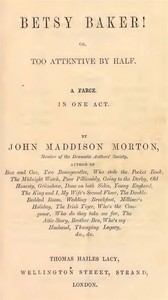
Betsy Baker! or, Too Attentive by Half; A Farce, in One Act — Edition Insights
(0 User reviews)
947
Project Gutenberg
2021
Not confirmed
English drama (Comedy); Women -- Drama; Farces
Readers of public-domain and historical texts
Project Gutenberg digital edition
en
Edition facts
Words
11,737
Reading time
52 min
Text sections
5
The source record for Betsy Baker! or, Too Attentive by Half; A Farce, in One Act — Edition Insights measures this digital text at 11,737 words, 52 min estimated reading time, and 5 detected text sections.
The text analysis averages about 13.1 words per sentence, while the detected sections provide another way to judge how the source is divided.
Project Gutenberg metadata also associates the work with “English drama (Comedy),” connecting these edition facts with the source record’s subject description.
Source:
Project Gutenberg record #64794
A farce in one act built on a love triangle, mistaken identity, and a laundress's scheme for a greengrocer's shop. The play's structure relies on rapid entrances, repeated exits, and escalating misunderstandings, with the recurring 'Ya—oo—oo' vocal failure and the veil letter as key plot devices.
Read the complete public-domain text at its original source.
Read on Project GutenbergThe farce opens with Marmaduke Mouser at the piano, repeatedly failing to hit the note “Ya—oo—oo” in a song, while his wife Anastasia throws down her work in irritation. This musical failure becomes a running gag, resurfacing as a marker of Mouser’s stubbornness and the couple’s domestic friction. The scene immediately establishes a pattern of interrupted actions: Mouser’s singing is cut short by his wife’s complaints, and his subsequent attempts to leave are thwarted by her demands. The stage directions emphasize doors on multiple sides, setting up a rhythm of characters darting in and out, often missing one another.
Doors and Delays: The Architecture of Misunderstanding
The play’s single act is built around a series of near-misses and mistimed entrances. The stage is a handsomely furnished apartment with doors in the flat, right and left center, and another door left second entrance. Characters frequently rush out one door just as another enters, creating a comic choreography of avoidance. For instance, Mouser exits left door flat as his wife enters from the opposite side, leaving Crummy to mediate. Later, Betsy peeps in cautiously, then exits and re-enters, timing her appearances to exploit the others’ absence. The physical layout becomes a character in itself, dictating who overhears what and who is left alone at crucial moments.
The Veil Letter: A Prop That Drives the Plot
A single prop—Mrs. Mouser’s veil—carries the plot’s central misunderstanding. Betsy discovers a letter inside the veil when it is left at the laundry. The letter, from Mouser, appoints a meeting, but Betsy cannot read it herself; she has it read aloud by “Big Charlotte,” a red-haired laundress with a powerful voice. The contents are broadcast across the laundry, forcing Betsy to invent a cover story. This chain of events—veil, letter, public reading—escalates the farce, turning a private scheme into a communal scandal. The veil reappears later as a token of Mouser’s attentiveness, linking the domestic and romantic threads.
Repetition and Escalation: The Rhythm of Farce
Morton employs repetition to build comic tension. Mouser’s repeated attempts to sing “Ya—oo—oo” mirror his repeated attempts to leave the house, each time thwarted by his wife or his own indecision. Betsy’s refrain “I want my Mouser!” grows louder each time, forcing Crummy to concede the greengrocer’s shop. The phrase “downright earnest” recurs, first from Crummy, then from Betsy, as the stakes of the pretended love affair rise. Even the stage directions echo: characters “rush out,” “peep in,” and “slam the door” in a predictable but escalating pattern, culminating in a climax of shouted demands and slammed doors.
Voice and Volume: From Singing to Shouting
The play’s humor often depends on vocal extremes. Mouser’s tuneless singing contrasts with his wife’s sharp complaints. Betsy’s description of Big Charlotte’s “very powerful organ” turns a simple reading into a public announcement. The stage directions specify volume: Betsy speaks “in a loud voice” and “louder still,” while Crummy hisses “Hush!” and “Be quiet.” The final scene likely involves a crescendo of overlapping voices, as characters shout over one another. This emphasis on volume—from the failed high note to the laundry’s collective “Lawks!”—makes the play as much an auditory experience as a visual one, suited to a live audience’s laughter.
Readers should pay attention to the timing of entrances and exits, as the farce’s comedy depends on who is onstage when a secret is revealed. The repeated use of the veil and the letter as physical objects that change hands and meanings is central to the plot’s momentum. Morton’s one-act structure rewards close attention to the rhythm of dialogue and the placement of doors, which together create a tightly wound mechanism of mistaken intentions and near-discoveries.
There’s a sweet, guileless chaos in these old one-acts, that farcical spiral of laundry schemes and missed cues—it lingers after the curtain. It reminds me, gently, of the same innocent mischief animating Santa Claus' Frolics — Inside the Classic, where holiday warmth softens similar confusions. Reading them feels like finding a forgotten letter in a coat pocket.
There are no reviews for this eBook.
There are no comments for this eBook.
Reader reflection
What was your reading experience?
Capture what you thought, learned, and would like to remember.
Your progress
0
/
10
2
Did this book hold your interest?
3
How likely are you to recommend this book?
4
How much effort did this book require?
5
What did you appreciate most?
6
Would you start a conversation about this book?
7
How clear did the writing feel?
8
Would a second reading be valuable?
9
In one sentence, what did you learn?
10