1

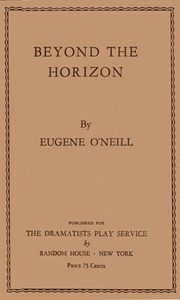
Beyond the Horizon — Story, Setting & Ideas
(0 User reviews)
2587
Project Gutenberg
2018
Not confirmed
Brothers -- Drama; Domestic drama; Farm life -- Drama
Readers of public-domain and historical texts
Project Gutenberg digital edition
en
Edition facts
Words
35,778
Reading time
156 min
Text sections
4
This digital edition of Beyond the Horizon — Story, Setting & Ideas is described by source-level measurements including 35,778 words, 2 hr 36 min estimated reading time, and 4 detected text sections.
The text analysis averages about 13.5 words per sentence, while the detected sections provide another way to judge how the source is divided.
Project Gutenberg metadata also associates the work with “Brothers -- Drama,” connecting these edition facts with the source record’s subject description.
Source:
Project Gutenberg record #58569
Eugene O'Neill's early play uses stark dialogue and shifting settings to trace the unraveling of Robert Mayo's dreams, as his brother Andrew's return exposes the fault lines in a marriage built on illusion.
Read the complete public-domain text at its original source.
Read on Project GutenbergEugene O'Neill's Beyond the Horizon opens with a stage direction that sets the road as a pale ribbon winding toward the horizon, a visual metaphor for the unattainable. The play's three acts, each separated by years, chart a steady contraction of possibility. The language shifts from Robert's poetic aspirations—his talk of "beauty" and "wanderlust"—to the blunt, accusatory exchanges of Act II, where Ruth's speech hardens into a weapon: "I hate the sight of you." O'Neill builds tension through repeated interruptions: the child's cry, the sound of a horse and carriage, Andrew's hail from the road. These intrusions punctuate the dialogue, marking moments when characters are forced to confront what they have tried to suppress.
The Rhythm of Return and Rupture
The play's structure hinges on returns—Andrew's homecoming, the reappearance of the sea in Act II, Scene II—each one a catalyst for revelation. O'Neill uses the stage directions to control tempo: a long pause after Robert throws Ruth away from him, then the noise of a carriage "suddenly struck by the same premonition." The characters listen "breathlessly, as to a sound heard in a dream." This slowing of time before Andrew's entrance heightens the emotional stakes. In contrast, the quarrel that precedes it is rapid, with overlapping accusations and exultant cries. O'Neill alternates between these staccato bursts and suspended silences, forcing the audience to feel the weight of what is left unsaid.
Voice as a Marker of Change
Robert's voice evolves from the dreamy, bookish tone of Act I—"I've been thinking for years"—to a harsh, commanding shout in Act II: "Stop!" Ruth's voice, initially restrained, escalates into a "defiant scream" as she declares her love for Andy. O'Neill marks these shifts with explicit parentheticals: (aghast), (fiercely), (exulting fiercely), (with a harsh laugh). The child's whimper from the bedroom serves as an aural counterpoint, a reminder of the domestic reality that the quarrel has shattered. Andrew's voice, heard only from offstage in the excerpt, is a hail—"Ahoy there!"—a sailor's greeting that contrasts with the farmhouse's interior tension. The play's vocal landscape is thus layered: the intimate, the violent, and the distant all compete for the listener's ear.
The Horizon as a Shifting Backdrop
O'Neill's settings mirror the characters' psychological states. Act I places the road at sunset, with the horizon visible; Act II, Scene II moves to a hilltop overlooking the sea, but the day is "hot and cloudless," offering no relief. The farmhouse interiors of Act II, Scene I and Act III are claustrophobic, with the road outside becoming a site of departure. The horizon itself is never static: in the opening stage direction it is a "pale ribbon" winding toward the distance; by Act III, it is glimpsed at sunrise, but the characters are trapped in a cycle of regret. The play's title thus functions as an ironic counterpoint—the horizon is always beyond, never reached.
The Weight of Unspoken History
The excerpts reveal a pattern of characters speaking as if they have been rehearsing their grievances for years. Ruth says, "I'm only saying what I've been thinking for years." Robert responds with a similar sense of belated recognition: "I've kept on telling myself that I must be wrong." O'Neill uses these lines to suggest that the marriage has been a long accumulation of silences, now shattered. The quarrel is not a sudden explosion but the eruption of a fault line that has been deepening since Act I. The play's pacing—three acts spanning eight years—allows these buried tensions to surface gradually, making the final confrontation feel both inevitable and devastating.
Readers should attend to O'Neill's use of offstage sounds—the child's cry, Andrew's hail, the carriage—as they function like musical cues, signaling shifts in power and awareness. The play's language rewards close attention to repetition: the word "fool" recurs across acts, binding Robert and Ruth in mutual accusation. The horizon, never described in the same way twice, invites readers to track how the characters' perceptions of possibility narrow over time.
Reading Beyond the Horizon, I kept thinking about the weight of unspoken choices. Robert's quiet surrender to a life he never wanted reminded me of another voice from the past, one also wrestling with land and longing. There’s a particular ache in that old play, Tecumseh : a Drama — Inside the Classic, a similar sense of dreams deferred by circumstance. Both feel less like stories and more like echoes of a familiar, restless heart.
There are no reviews for this eBook.
There are no comments for this eBook.
Reader reflection
Take a moment to reflect on this book
Create a short personal record of your experience with this book.
Your progress
0
/
10
2
What was your overall reaction to the book?
3
Is this a title you would suggest to others?
4
Did the language feel accessible?
5
How did the reading compare with what you expected?
6
What did you think about the pace?
7
Did you relate to its people, ideas, or situations?
8
How valuable was this book for your own interests?
9
What is the main idea you are taking away?
10