1

Flowers from Shakespeare's Garden: A Posy from the Plays — A Closer Reading
(0 User reviews)
520
Project Gutenberg
2020
Not confirmed
Shakespeare, William, 1564-1616 -- Illustrations; English drama -- Illustrations; Flowers in literature
Readers of public-domain and historical texts
Project Gutenberg digital edition
en
Edition facts
Words
3,362
Reading time
15 min
Text sections
7
Before opening Flowers from Shakespeare's Garden: A Posy from the Plays — A Closer Reading, the edition data offers a quick orientation: 3,362 words, 15 min estimated reading time, and 7 detected text sections.
The text analysis averages about 24.9 words per sentence, while the detected sections provide another way to judge how the source is divided.
Project Gutenberg metadata also associates the work with “Shakespeare, William, 1564-1616 -- Illustrations,” connecting these edition facts with the source record’s subject description.
Source:
Project Gutenberg record #64102
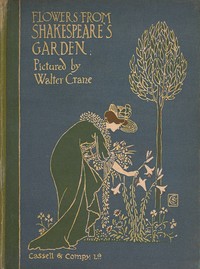
Walter Crane's illustrated collection pairs Shakespearean flower references with his own botanical drawings, framed by a dedication to the Countess of Warwick's garden. The book moves from play excerpts to visual blooms, emphasizing the moral and symbolic weight of plants in the dramas.
Read the complete public-domain text at its original source.
Read on Project GutenbergWalter Crane's Flowers from Shakespeare's Garden opens with a dedication to the Countess of Warwick, whose Old English Garden at Easton Lodge inspired the volume. The book then presents a series of Shakespearean quotations, each paired with Crane's botanical illustration. The structure is deceptively simple: a line or two from a play, followed by a full-page drawing of the flower named. But the arrangement is not alphabetical or by play; instead, it seems to follow a logic of visual contrast and thematic echo. The first excerpt, from Much Ado About Nothing, has Hero asking for Carduus Benedictus, and Beatrice teasing about a moral meaning. Crane places this dialogue opposite a thistle, emphasizing the plant's prickly reputation and its medicinal use. The effect is to make the reader pause on each plant's dual nature—both physical and symbolic.
A Garden of Quotations
The book's core is a sequence of Shakespearean passages, each centered on a flower or herb. Crane selects lines that are often metaphorical: the strawberry growing under the nettle in Henry V, the hawthorn giving sweeter shade than a canopy in 3 Henry VI. These are not mere botanical lists; they are moments where characters use plants to argue about rank, love, or mortality. The quotations are short, rarely more than four lines, and Crane omits the surrounding context. This forces the reader to consider the flower as the primary subject, not the plot. The effect is like walking through a gallery where each frame holds a single bloom and a single voice.
Movement Between Plays
Crane does not group the excerpts by genre or chronology. A comedy (Much Ado) is followed by a history (Henry V), then another history (3 Henry VI), then a tragedy (Troilus & Cressida). This juxtaposition highlights how the same plant can carry different meanings across contexts. The thistle in Much Ado is a joke about moralizing; the laurel in Troilus is a symbol of victory and age. By moving between plays, Crane suggests that Shakespeare's botanical imagery is not fixed but fluid, adapting to each dramatic situation. The reader is invited to compare uses: the strawberry's humility in Henry V versus the hawthorn's pastoral simplicity in 3 Henry VI.
Recurring Images: The Prickly and the Sweet
A pattern emerges in the selected excerpts: many contrast sharp, defensive plants with soft, fruitful ones. The thistle (Carduus Benedictus) is both holy and thorny. The nettle is the strawberry's neighbor. The hawthorn has thorns but gives shade. This duality is central to Crane's visual approach. His illustrations, though not described in the text, likely emphasize texture—the jagged leaves of thistles, the smooth berries of strawberries. The quotations themselves reinforce this: the strawberry 'grows underneath the nettle,' suggesting protection or contrast. Crane's garden is not a peaceful idyll but a place of moral and physical edges.
The Dedication as a Frame
The book is inscribed to the Countess of Warwick, whose garden at Easton Lodge is called 'delightful' and 'Old English.' This dedication does more than acknowledge patronage; it situates the book within a real, cultivated space. Crane's project is to translate that garden into a literary one, where each flower has a Shakespearean pedigree. The closing line, 'Finis,' is followed by the printer's mark, but the final quotation—'Prerogative of age, crowns, sceptres, laurels'—from Troilus & Cressida—ends on a note of authority and endurance. The book thus moves from a specific garden to a universal one, from the Countess's grounds to the timelessness of Shakespeare's verse.
This edition preserves Crane's original sequence, including the inconsistent punctuation noted by the transcriber. Readers may find it useful to read the excerpts aloud, as the rhythms of Shakespeare's verse are essential to the effect. The book is best approached as a series of meditations, each page a single thought. Do not expect a narrative; instead, let each flower and its line stand alone, then consider how they echo across the plays. Crane's garden is a place of connections, not conclusions.
Leafing through Crane’s posies, I kept thinking of the Countess’s garden as a kind of quiet prescription—each bloom a small, patient remedy for whatever ailed the soul. That gentle, almost playful seriousness reminded me of Dr. Hardhack's Prescription: A Play for Children in Four Acts — Reading Companion, which feels like the same old apothecary shelf, rearranged for younger hands.
There are no reviews for this eBook.
There are no comments for this eBook.
Reader reflection
Before you leave, reflect on the book
Use these questions to collect your thoughts before moving on.
Your progress
0
/
10
2
What was your overall reaction to the book?
3
Is this a title you would suggest to others?
4
Did the language feel accessible?
5
Is this a title worth rereading?
6
How clear did the writing feel?
7
Which part made the strongest impression?
8
What did you think about the pace?
9
What changed or sharpened your thinking?
10