1

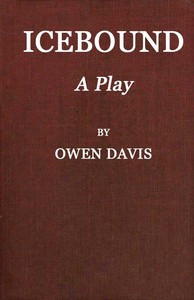
Icebound: A Play — Key Ideas to Explore
(0 User reviews)
81
Project Gutenberg
2019
Not confirmed
American drama -- 20th century; Inheritance and succession -- Drama; Farm life -- Drama; Maine -- Drama
Readers of public-domain and historical texts
Project Gutenberg digital edition
en
Edition facts
Words
24,084
Reading time
105 min
Text sections
8
Icebound: A Play — Key Ideas to Explore can be approached with a clearer sense of reading commitment from its source measurements: 24,084 words, 1 hr 45 min estimated reading time, and 8 detected text sections.
The text analysis averages about 12.5 words per sentence, while the detected sections provide another way to judge how the source is divided.
Project Gutenberg metadata also associates the work with “American drama -- 20th century,” connecting these edition facts with the source record’s subject description.
Source:
Project Gutenberg record #59777
Owen Davis's 1923 play set in a Maine farmhouse where a family awaits the death of its matriarch. Through clipped dialogue and stark stage directions, Davis builds a portrait of emotional and physical coldness, using the word 'icebound' as a metaphor for the Jordan family's inherited hardness.
Read the complete public-domain text at its original source.
Read on Project GutenbergOwen Davis's Icebound opens not with action but with a stage direction that sets the tone: the parlor of the Jordan homestead is 'as dull and as drab as the lives of those who have lived within its walls.' The October landscape outside—'brown and lifeless' trees against a gray sky—mirrors the interior, where cleanliness is present but comfort and beauty are absent. Davis, in his foreword, claims to draw 'a true picture' of northern New England people, rejecting the 'Rube' caricature of conventional theatre. The dialogue that follows bears this out: it is terse, repetitive, and weighted with unspoken resentment.
The Weight of Silence and Repetition
Davis builds tension through what characters leave unsaid. In Act One, Ben and Jane converse in fragments: 'You mean thread?' 'Yes.' 'This it?' 'Would you call that black?' The exchange is almost absurdly literal, yet it reveals a household where communication has been ground down to mere function. Ben's description of winter life—'Most folks quiet, because they've said all the things they've got to say a hundred times'—is a self-reflexive comment on the play's own dialogue. The repetition of phrases like 'sort of blue' and 'maybe this is it' creates a rhythm of stalled emotion, as if the characters are trapped in a loop they cannot break.
The French Family as a Counterpoint
Ben's memory of the French family he stayed with during the war provides the play's only glimpse of warmth. He recalls them singing and laughing at the table, a contrast to the Jordan household where 'laughter needs the sun, same as flowers do.' The details are deliberately vague—the dress is 'sort of blue,' the house is 'nice' but not like the Jordan parlor—yet they carry an emotional weight that the present-tense scenes lack. Jane, sewing, prompts him to repeat the story, and her questions ('Sometimes you say dark blue!') suggest she is trying to hold onto that imagined warmth herself. The French family exists as a ghost of what the Jordans are not.
Setting as Character: The Icebound Homestead
The stage directions in Icebound do more than describe a room; they establish a moral climate. The parlor has been 'for a hundred years the rallying point of the Jordan family,' yet it offers 'no sign of either comfort or beauty.' The windows show a 'bleak countryside' in late October, and later, in Act Two, the sitting room is set two months later, in afternoon light that presumably offers no more warmth. Davis uses the word 'icebound' explicitly in the dialogue: Ben says, 'Icebound, that's what we are all of us, inside and out.' The physical coldness of the Maine winter becomes a metaphor for the family's emotional paralysis, a state that seems inherited and inescapable.
Dialogue as a Tool of Characterization
Davis differentiates his characters through their speech patterns. Ben's lines are often halting and self-conscious, as when he describes the French family: 'I don't know, things—well—useful, you know, but nice, not like this.' Jane, by contrast, speaks in shorter, more pointed questions, probing Ben's memories. The other relatives, glimpsed in the opening scene, are described as 'gathered to await the death of the old woman,' but their voices are not heard in the excerpt; the focus remains on Ben and Jane, whose dialogue reveals a shared longing for something beyond the farm. The play's language is plain, but its repetitions and pauses carry a subtext of suppressed desire and regret.
Readers should attend to what Davis leaves out as much as what he includes. The play's power lies in its restraint: the offstage death, the unspoken resentments, the memories that cannot be fully articulated. The dialogue rewards close attention to its rhythms—the way characters finish each other's sentences or fail to, the way a single word like 'blue' can carry the weight of an entire lost world. Icebound is a play about what it means to be born into a place and a family that feels like a trap, and Davis's spare, precise writing makes that trap feel both specific and universal.
That rain kept tapping the window while the Jordans’ frozen grief seeped through the pages, and I found myself missing the thaw. Later, almost without thinking, I picked up The McNaughtens — Reading Companion—its quieter warmth felt like a hand on my shoulder. It didn’t answer Davis’s coldness; it just sat beside it, remembering.
There are no reviews for this eBook.
There are no comments for this eBook.
Reader reflection
Record your reading impressions
A brief reflection can help important ideas stay with you longer.
Your progress
0
/
10
2
What was your overall reaction to the book?
3
Would you encourage someone else to read it?
4
Did the language feel accessible?
5
Would you like to discuss this book with someone?
6
How would you describe its reading pace?
7
How clear did the writing feel?
8
What was the strongest part of the book?
9
What is the main idea you are taking away?
10