1

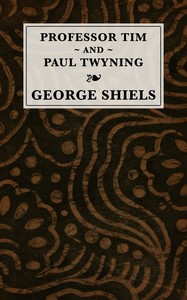
Professor Tim & Paul Twyning — Context and Discussion
(0 User reviews)
1114
Project Gutenberg
2025
Not confirmed
Comedy plays; English drama -- Irish authors
Readers of public-domain and historical texts
Project Gutenberg digital edition
en
Edition facts
Words
48,335
Reading time
211 min
Text sections
9
This digital edition of Professor Tim & Paul Twyning — Context and Discussion is described by source-level measurements including 48,335 words, 3 hr 31 min estimated reading time, and 9 detected text sections.
The text analysis averages about 9.1 words per sentence, while the detected sections provide another way to judge how the source is divided.
Project Gutenberg metadata also associates the work with “Comedy plays,” connecting these edition facts with the source record’s subject description.
Source:
Project Gutenberg record #76449
Two comedies by George Shiels, set in rural Ireland, where dialogue and stage directions reveal character through precise diction, interrupted speech, and physical comedy. The plays hinge on misunderstandings, family tensions, and the gap between self-image and reality.
Read the complete public-domain text at its original source.
Read on Project GutenbergGeorge Shiels’s two comedies, Professor Tim and Paul Twyning, share a sharp ear for rural Irish speech and a fondness for characters who talk themselves into corners. In Professor Tim, the title character’s return from abroad sets off a chain of polite evasions and blunt rejoinders; in Paul Twyning, a tramp-plasterer’s wheedling tone collides with the magistrate’s formal dignity. Both plays were first staged at the Abbey Theatre, and the dialogue carries the rhythms of performance—interruptions, trailing-off sentences, and sudden shifts between complaint and affection.
Diction and Social Markers
Shiels distinguishes characters by their vocabulary and syntax. In Professor Tim, John Scally’s exclamations—“By the hedges, it’s grand! It’s outrageous. Atrocious!”—pile up contradictory adjectives, suggesting a man who feels strongly but cannot settle on a single word. Mrs. Scally’s promise to “talk less” is immediately undercut by her rising to leave, a small contradiction that the play treats with gentle irony. In Paul Twyning, the magistrate James Deegan speaks in measured, formal phrases (“I want to speak a word”), while Paul’s reply—“Yes, your worship”—mixes deference with a hint of mockery. The contrast between the tramp’s easy familiarity and the magistrate’s stiff propriety sets up the play’s central tension.
Stage Directions as Character Clues
Shiels’s stage directions do more than describe action; they reveal inner states. In Professor Tim, Peggy Scally “slips a ring on and off her finger” before wrapping jewellery, a gesture that conveys nervous anticipation without a word of explanation. Later, Hugh O’Cahan enters “on tiptoe” and uses “the old route” through the parlour window, establishing him as a character accustomed to sneaking. The direction that he wears “neither a collar nor tie” reinforces his casual, slightly disreputable air. In Paul Twyning, the setting itself—a “new kitchen” with “raw” walls and unpainted wood—mirrors the unfinished business of the family relationships. The piled-up furniture from the old house suggests a family caught between past and present.
Interrupted Speech and Miscommunication
Both plays rely on characters talking past each other. In Professor Tim, Hugh O’Cahan’s teasing reference to a plant he “only touched once in four years” during an eclipse of the moon is a comic exaggeration that Peggy ignores, focusing instead on the knocked-over plant. The exchange shows how each character pursues their own conversational thread. Later, Joseph Kilroy’s declaration that he would “marry any of the other three … any one of them that would have me” is met with practical advice from Peggy, who redirects him toward Susan. The dialogue moves in quick, overlapping bursts, with characters often finishing each other’s thoughts or contradicting themselves. In Paul Twyning, the offstage call “Anybody here?” is answered by Paul’s “Yes, your worship; Paul’s here,” a reply that asserts his presence while acknowledging the magistrate’s authority—a small but telling instance of the tramp’s verbal agility.
Physical Comedy and Gesture
Shiels embeds comedy in physical actions that the stage directions make explicit. In Professor Tim, Hugh O’Cahan “goes to room scratching his head” when asked to fetch cigars, a gesture that suggests bewilderment or reluctance. Peggy’s throwing her arms around her mother and kissing her, followed by the command “Come here, Hugh, and kiss mother,” turns an emotional moment into a comic challenge. Professor Tim’s response—“That’s a tall order, Hugh”—acknowledges the awkwardness. In Paul Twyning, the opening image of Paul “mixing mortar on the floor with a shovel” establishes him as a worker, but his white jacket and overalls also hint at a performative aspect—he is playing a role. The physical setting of the unfinished kitchen, with its raw walls and unpainted doors, becomes a backdrop for the characters’ incomplete negotiations.
These two plays reward attention to the small verbal and physical details that Shiels uses to build character and conflict. Readers may find it useful to imagine the stage business behind the lines—the pauses, the gestures, the objects handled or ignored. The dialogue is dense with implication, and what characters do not say often matters as much as what they do.
Years among these shelves taught me that Shiels’s interrupted, self-deceiving voices carry a lonely ache, much like the searching quiet in Where There is Nothing, which I keep beside them. Both know how people stumble over what they cannot say, and I have often slid one toward the other, sharing that kinship. Where There is Nothing Being Volume I of Plays for an Irish Theatre — Edition Insights feels like an old friend to Shiels’s world.
There are no reviews for this eBook.
There are no comments for this eBook.
Reader reflection
What was your reading experience?
Capture what you thought, learned, and would like to remember.
Your progress
0
/
10
2
What was your overall reaction to the book?
3
Would you recommend this book to another reader?
4
Did the language feel accessible?
5
Could you follow the author’s main argument?
6
Would you start a conversation about this book?
7
How did the pace of the book feel?
8
How would you rate its originality?
9
What changed or sharpened your thinking?
10