1

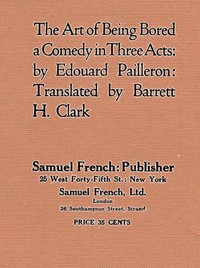
The Art of Being Bored: A Comedy in Three Acts — Reading Notes
(0 User reviews)
1312
Project Gutenberg
2016
Not confirmed
Comedy plays; French drama -- Translations into English
Readers of public-domain and historical texts
Project Gutenberg digital edition
en
Edition facts
Words
30,522
Reading time
133 min
Text sections
13
The catalog record for The Art of Being Bored: A Comedy in Three Acts — Reading Notes provides practical reading context through 30,522 words, 2 hr 13 min estimated reading time, and 13 detected text sections.
The text analysis averages about 10.4 words per sentence, while the detected sections provide another way to judge how the source is divided.
Project Gutenberg metadata also associates the work with “Comedy plays,” connecting these edition facts with the source record’s subject description.
Source:
Project Gutenberg record #53334
Edouard Pailleron's 19th-century French comedy, translated by Barrett H. Clark, satirizes intellectual pretension through rapid-fire dialogue and a salon setting, where characters debate love and science amid social maneuvering.
Read the complete public-domain text at its original source.
Read on Project GutenbergFrom the first lines of The Art of Being Bored, the play establishes itself as a comedy of talk, not action. The excerpt shows a salon full of characters who speak in elaborate, self-conscious declarations—Bellac’s rhapsody on “psychic love” is met with the Duchess’s blunt interjection, “Nonsense!” The dialogue moves at a brisk, almost farcical pace, with interruptions and asides that undercut every grand statement. Pailleron’s voice is sharp and ironic, using the structure of a three-act play to build tension between romantic idealism and practical cynicism.
The Rhythm of Interruption
The excerpt reveals a distinctive narrative rhythm: characters rarely finish a thought before someone cuts in. Bellac’s speech on love is repeatedly broken by the Duchess’s “Nonsense!” and the ladies’ exclamations. This pattern of interruption creates a layered texture, where the audience hears both the speaker’s rhetoric and the listeners’ immediate reactions. The effect is a kind of verbal ping-pong that keeps the scene lively and exposes the gap between what is said and what is meant. Pailleron uses this technique to satirize the salon’s intellectual posturing—every lofty idea is promptly deflated by a practical remark or a mocking aside.
Voice as Characterization
Each character in the excerpt speaks with a distinct verbal fingerprint. Bellac favors florid, abstract language: “the mingling of two spirits, their flight far from the terrestrial mire.” The Duchess counters with blunt, concrete statements: “Laura, the mother of eleven, my dear Monsieur!” Suzanne’s lines are direct and practical, offering a handkerchief and a drink. These vocal contrasts do more than identify speakers—they embody the play’s central conflict between idealism and realism. The translator, Barrett H. Clark, preserves these differences in English, maintaining the original French play’s reliance on tone and tempo to define personality.
Pacing and the Salon Setting
The physical setting—a salon with a table, tray, and glasses—anchors the dialogue in a confined space. This limitation forces the action to unfold through conversation alone. The pacing accelerates during Bellac’s speech, with stage directions like “(Everyone rises. Confused murmurs of conversation.)” indicating a crescendo of social energy. Then, as quickly as it rises, the tempo drops into private asides: “(Aside to the Duchess) Look, Aunt!” This ebb and flow mimics the rhythms of real social gatherings, where public performance and private commentary alternate. Pailleron exploits this structure to keep the comedy moving without physical action, relying on the audience’s ear for nuance.
Readers approaching The Art of Being Bored should attend to the play’s verbal texture rather than expecting plot-driven comedy. The humor lies in the gaps between what characters say and what they mean, and in the rapid-fire exchanges that reveal social hierarchies. Pay attention to who interrupts whom, and how the tone shifts between public declamation and private remark—these are the play’s true dramatic engines.
Reading this salon’s rapid-fire chatter brought back my grandmother’s parlor, where laughter masked our family’s deep silences. I remembered a quiet evening with Shakespeare Study Programs; The Comedies — Text and Context, and felt the same gentle ache—how we perform our own earnestness, waiting for someone to notice the seams in our cleverness.
There are no reviews for this eBook.
There are no comments for this eBook.
Reader reflection
Take a moment to reflect on this book
Create a short personal record of your experience with this book.
Your progress
0
/
10
2
What was your overall reaction to the book?
3
Would you encourage someone else to read it?
4
How easy was the book to follow?
5
How distinctive were its ideas or approach?
6
What did you think about the pace?
7
How useful were the ideas in this book?
8
How closely did the book connect with your experience?
9
In one sentence, what did you learn?
10