
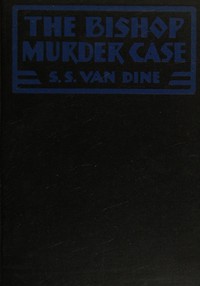
The Bishop murder case by S. S. Van Dine
Picture this: New York City in the 1920s. A man is found dead in his home, shot through the heart with an arrow. It's strange, but it seems like it could be an accident. Then, a mysterious note arrives, signed by someone calling themselves 'The Bishop,' and it quotes the old nursery rhyme, 'Who Killed Cock Robin?' Suddenly, it's clear this was no accident. It's murder, and the killer is announcing it with a children's verse.
The Story
The brilliant but somewhat snobbish amateur detective Philo Vance is on the case. As he investigates, more bodies turn up. Each new victim is connected to the same small, intellectual social circle, and each death mirrors another classic nursery rhyme. A man falls from a great height ('Humpty Dumpty'). Another is found near a wall ('Goosey, Goosey, Gander'). The killer, 'The Bishop,' is literally using a child's book of rhymes as a murder manual, sending taunting notes to the police and the press. Vance must get inside the mind of a criminal who sees human lives as pieces in a perverse game. The pressure is on to crack the code of the rhymes and stop the murders before the next verse claims another life.
Why You Should Read It
This book is a masterclass in the 'locked room' style of mystery, but with a psychological twist that feels fresh even today. The real hook isn't just 'whodunit,' but 'why are they doing it this way?' The use of nursery rhymes creates an unsettling contrast—something familiar and sweet turned into something sinister. Philo Vance can be a bit of a know-it-all, but his deductions are fascinating to follow. You feel like you're solving the puzzle alongside him, looking for clues in every character's past and every line of those creepy rhymes. It's less about bloody action and more about the chilling intellect behind the crimes.
Final Verdict
This is the perfect book for anyone who loves classic, puzzle-box mysteries from the Golden Age of detective fiction. If you enjoy authors like Agatha Christie or stories where the 'how' is just as important as the 'who,' you'll be right at home. It's also a great pick for readers who like a side of psychology with their crime, and who don't mind a detective who's confident to the point of arrogance. Just be warned: you might never hear 'Rock-a-bye Baby' the same way again.
Legal analysis indicates this work is in the public domain. It serves as a testament to our shared literary heritage.
Donald Taylor
7 months agoIt took me a while to process the complex ideas here, but the objective evaluation of the pros and cons is very refreshing. I feel much more confident in my knowledge after finishing this.
Donald Hernandez
2 years agoUnlike many other resources I've purchased before, the way it handles controversial points with balance is quite professional. I'll be citing this in my upcoming project.
Margaret Lopez
1 year agoFrom a researcher's perspective, the critical analysis of current industry standards is very timely. I’ll definitely be revisiting some of these chapters again soon.
Barbara Davis
7 months agoMy first impression was quite positive because the breakdown of complex theories into digestible segments is masterfully done. The price-to-value ratio here is simply unbeatable.

Linda Miller
1 year agoVery satisfied with the depth of this material.