1

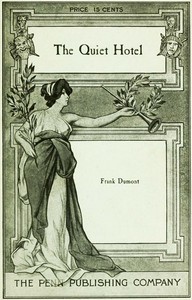
The Quiet Hotel: A Farcical Sketch in One Act — Story, Setting & Ideas
(0 User reviews)
999
Project Gutenberg
2021
Not confirmed
American drama; Actresses -- Drama; Farces; Hotels -- Drama
Readers of public-domain and historical texts
Project Gutenberg digital edition
en
Edition facts
Words
7,176
Reading time
32 min
Text sections
6
The catalog record for The Quiet Hotel: A Farcical Sketch in One Act — Story, Setting & Ideas provides practical reading context through 7,176 words, 32 min estimated reading time, and 6 detected text sections.
The text analysis averages about 12.1 words per sentence, while the detected sections provide another way to judge how the source is divided.
Project Gutenberg metadata also associates the work with “American drama,” connecting these edition facts with the source record’s subject description.
Source:
Project Gutenberg record #65716
Frank Dumont's one-act farce uses a runaway train gag and an actress's failed tragedy to dismantle the 'quiet hotel' premise, with Rubber-Neck's toy locomotive and repeated cues driving the comedy.
Read the complete public-domain text at its original source.
Read on Project GutenbergThe Quiet Hotel opens with a contradiction: a hotel advertised as 'very quiet' is immediately invaded by Miss Calcium, an actress whose traveling suit is 'very pronounced and dashing in style.' The play’s structure hinges on escalating disruptions—first her single suitcase, then her attempt at a tragic rescue scene, and finally Rubber-Neck’s toy train. Dumont builds the farce around repeated cues and missed signals, so that the hotel’s promised quiet becomes the joke that keeps the action moving.
The Recurring Image of the Train
The train is the play’s central prop and its most persistent joke. Miss Calcium lies on the floor as if on railroad tracks, calling for rescue at 'sixty miles a second.' Susan hops about, missing her cue, until Rubber-Neck enters with a small tin locomotive on a string, ringing a dinner bell and blowing a whistle. The noise grows louder and nearer, but the toy train is deliberately small—a deflation of the melodramatic rescue. Dumont repeats the train whistle and bell sounds, and the phrase 'All-l-l aboard' appears three times, first from Rubber-Neck, then from Susan, and finally from Miss Calcium as she renames the trio the 'Calcium Comedy Company.' The train image moves from imagined threat to literal toy to metaphor for their escape to Broadway.
Movement Between Quiet and Noise
The play’s scenes shift rapidly between stillness and chaos. The opening description promises a quiet hotel, but the stage directions call for a 'music hurry' and a whistle heard in the distance. Miss Calcium’s tragedy rehearsal is interrupted by Susan’s hopping and Rubber-Neck’s bell-ringing. Each time the noise peaks, a character reasserts the hotel’s quiet—'This is a quiet hotel'—only to be drowned out again. The final movement is a collective decision to leave: 'No more hotel for mine!' says Susan, and Miss Calcium declares they will 'take the Quiet Hotel to Broadway and make a noise with it.' The structure thus moves from enforced quiet to chosen noise, with the hotel’s name becoming ironic.
Voice and Dialect as Comic Markers
Dumont distinguishes characters through their speech patterns. Rubber-Neck uses dialect: 'Didn’t you done tole me to stick to it?' and 'It’s goin’ to be still quieter.' Miss Calcium speaks in theatrical hyperbole—'Oh, dramatic art! What crimes are committed in thy name!'—while Susan’s lines are short and practical: 'What’s my cue?' and 'That’s it—that’s the way I’m going.' The contrast between Miss Calcium’s elevated tragedy and Rubber-Neck’s vernacular comedy drives the farce. When Rubber-Neck insists he is 'a-stickin’' to his cue, he literalizes the theatrical instruction, turning a rehearsal into a battle of wills. The dialogue relies on repeated phrases and missed cues, so that the humor comes from the collision of different vocal styles.
The Structure of the Rescue Scene
The rescue scene is the play’s centerpiece, built on a series of escalating failures. Miss Calcium lies on the tracks and gives the cue: 'Save me—some one—save me!' Susan repeats the line instead of acting. Miss Calcium sits up to correct her, then lies down again. The train noise grows, Miss Calcium screams, and Susan still hesitates. Finally, Miss Calcium shouts over the din: 'Come on and save me! That’s your cue!' The scene is structured as a repeated loop of instruction and error, with the rescue itself delayed until Rubber-Neck’s entrance with the toy train. Dumont uses the stage directions to control timing: the whistle and noise are cued to grow 'louder and nearer,' but the actual rescue is anticlimactic—Rubber-Neck simply prances across the stage, avoiding everyone. The scene ends with Miss Calcium’s exasperated line, which both critiques and celebrates the absurdity.
Readers should watch for how Dumont uses the stage directions themselves as part of the comedy. The repeated cues, the toy train, and the characters’ insistence on the hotel’s quiet all work together to create a farce that is as much about theatrical timing as about plot. The play rewards attention to its small physical details: the whistle snatched from Rubber-Neck’s teeth, the bell that keeps ringing, and the final invitation to 'All-l-l aboard.'
There’s something tender about farce that refuses to settle, like Rubber-Neck’s little train forever bumping against the quiet’s promise. It made me think of The Disguising at Hertford, where costumes also unravel their own certainty, softly. I keep returning to how both plays let noise win, gently, and that feels like a comfort. The Disguising at Hertford — Key Ideas to Explore stays with me that way, like an old friend’s half-finished joke.
There are no reviews for this eBook.
There are no comments for this eBook.
Reader reflection
What was your reading experience?
Capture what you thought, learned, and would like to remember.
Your progress
0
/
10
2
How much did you enjoy the reading experience?
3
Is this a title you would suggest to others?
4
Did the language feel accessible?
5
How did the reading compare with what you expected?
6
Would you start a conversation about this book?
7
Would you read this book again?
8
Did any part of the book feel personally relevant?
9
What did this book teach you most?
10