1

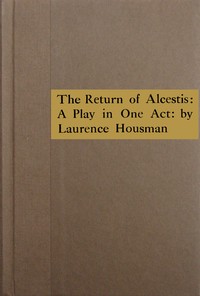
The return of Alcestis — Text and Context
(0 User reviews)
978
Project Gutenberg
2025
Not confirmed
One-act plays; Alcestis, Queen, consort of Admetus, King of Pherae -- Drama
Readers of public-domain and historical texts
Project Gutenberg digital edition
en
Edition facts
Words
7,141
Reading time
32 min
Text sections
4
Before opening The return of Alcestis — Text and Context, the edition data offers a quick orientation: 7,141 words, 32 min estimated reading time, and 4 detected text sections.
The text analysis averages about 15.8 words per sentence, while the detected sections provide another way to judge how the source is divided.
Project Gutenberg metadata also associates the work with “One-act plays,” connecting these edition facts with the source record’s subject description.
Source:
Project Gutenberg record #75270
Laurence Housman's one-act play reimagines the return of Alcestis from the dead, focusing on the tension between her sacrificial love and Admetus's desire. Through spare dialogue and choral commentary, the play explores whether resurrection can restore what death has changed.
Read the complete public-domain text at its original source.
Read on Project GutenbergLaurence Housman's The Return of Alcestis condenses the ancient myth into a single act, stripping away epic scope to focus on the fraught reunion between Alcestis and Admetus. The play opens with Hymen's blessing, but the bridal chamber quickly becomes a space of emotional and philosophical conflict. Housman's diction oscillates between ritual formality and raw intimacy, as when Alcestis tells Admetus, 'My joy I gave before I died; nor took it to the grave; nor brought it thence.' The choral odes, with their imagery of springs and rivers, frame the action as a cycle of loss and return, yet the dialogue undercuts any simple restoration.
Diction of Sacrifice and Possession
Housman's word choices repeatedly pit giving against taking. Alcestis speaks of joy she 'gave' and did not 'take' to the grave, while Admetus demands, 'Give me to drink again!' The verb 'give' appears in nearly every exchange, shifting from altruistic to transactional. When Admetus declares 'Now art thou mine! O bride of every sense!' the possessive pronoun clashes with Alcestis's earlier assertion that her life is her own. The nurse later echoes this tension, lamenting that her hands 'chain thee to the life that thou wouldst forget.' The language of bondage and ownership pervades the play, suggesting that resurrection may be a form of captivity.
Dialogue as Psychological Duel
The central confrontation between Alcestis and Admetus unfolds in stichomythia—short, rapid exchanges that reveal their divergent desires. Admetus's lines grow increasingly urgent: 'Yea, for I thirst!' and 'Come! for I call!' while Alcestis's responses become more withdrawn: 'My flesh is thine: the life therein my own.' This rhythmic clash mirrors the emotional distance between them. Housman uses the form to dramatize a struggle not of wills but of worldviews: Admetus sees Alcestis's return as a restoration of his happiness; Alcestis treats her body as a loan. The dialogue's brevity leaves much unsaid, inviting the audience to read between the lines.
Choral Commentary and Natural Imagery
The chorus of women and men frame the action with odes that draw on natural cycles. The first semi-chorus compares Alcestis's return to springs that 'sink and are lost, yet rise and return.' This imagery suggests renewal, but the play's conclusion subverts it: Alcestis dies again, and the chorus laments 'the eyes, the eyes!' The second semi-chorus speaks of 'the gold of the sun' lying 'all bright and at rest,' a peaceful image that contrasts with Admetus's anguish. Housman uses the chorus not to explain but to deepen the ambiguity—nature's cycles offer no guarantee of happy endings.
Stage Directions and Spatial Symbolism
The set design reinforces the play's themes. The bridal couch stands before a screen with curtained entrances, suggesting concealment and revelation. The domestic altar, where Hymen stands with a torch, anchors the action in ritual. Yet the torch, a symbol of marriage and life, becomes ironic when Alcestis dies in Admetus's arms. Housman's stage directions are sparse but pointed: 'He bears her to the bed' and 'He covers his face with his robe.' These gestures carry the weight of the dialogue, showing Admetus's transition from desire to horror. The nurse's entrance and the children's silent presence underscore the domestic tragedy at the heart of the myth.
Housman's play resists easy interpretation. The ending—Alcestis's second death—may be read as a rejection of a life reduced to object, or as a tragic failure of love. Readers attentive to the play's verbal patterns will notice how Housman uses repetition and variation to create meaning. The choral odes, with their natural imagery, offer a counterpoint to the dialogue's intensity. This edition invites careful attention to the interplay between what is said and what is left unsaid.
I keep thinking about how Alcestis returns to a man who loved her but couldn’t quite see her—resurrection making distance, not closeness. It reminded me of something quieter in Getting Married — Reading Notes, where the weight of expectation shapes what we offer each other. That ache of unfinished understanding stayed with me for days.
There are no reviews for this eBook.
There are no comments for this eBook.
Reader reflection
Before you leave, reflect on the book
Use these questions to collect your thoughts before moving on.
Your progress
0
/
10
2
How much did you enjoy the reading experience?
3
Is this a title you would suggest to others?
4
What was the reading difficulty like?
5
How useful did the reading feel?
6
Do you expect to return to this book?
7
How closely did the book connect with your experience?
8
How much did the book move you?
9
What did this book teach you most?
10