1

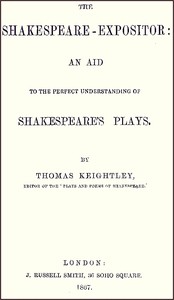
The Shakespeare-Expositor: An Aid to the Perfect Understanding of Shakespeare's Plays — Key Ideas to Explore
(0 User reviews)
461
Project Gutenberg
2014
Not confirmed
Shakespeare, William, 1564-1616 -- Outlines, syllabi, etc.; Drama -- Outlines, syllabi, etc.
Readers of public-domain and historical texts
Project Gutenberg digital edition
en
Edition facts
Words
128,025
Reading time
557 min
Text sections
29
For The Shakespeare-Expositor: An Aid to the Perfect Understanding of Shakespeare's Plays — Key Ideas to Explore, the stored edition analysis reports 128,025 words, 9 hr 17 min estimated reading time, and 29 detected text sections.
The text analysis averages about 13.2 words per sentence, while the detected sections provide another way to judge how the source is divided.
Project Gutenberg metadata also associates the work with “Shakespeare, William, 1564-1616 -- Outlines, syllabi, etc.,” connecting these edition facts with the source record’s subject description.
Source:
Project Gutenberg record #45160
Thomas Keightley's 1867 manual offers textual corrections and explanatory notes for Shakespeare's plays, focusing on emendations to meter, grammar, and sense, with detailed commentary on passages from The Tempest and other works.
Read the complete public-domain text at its original source.
Read on Project GutenbergThomas Keightley opens his 1867 manual by addressing readers who rely on the simple text of Shakespeare, lacking a voluminous annotated edition. He positions his work as indispensable to his own edition of the plays, likening it to diagrams for Euclid. Keightley's method is forensic: he scrutinizes meter, grammar, and printer's errors, proposing emendations grounded in textual evidence. For instance, in The Tempest, he argues that Antonio's line "Go sleep, and hear us not" should read "hear us" because the negative was likely omitted—Antonio would not wish to be heard. Such precise observations reveal Keightley's commitment to restoring Shakespeare's intended sense through careful analysis of diction and structure.
Emendations Driven by Meter and Sense
Keightley frequently intervenes where meter or meaning seems compromised. In The Tempest, he proposes adding "wind" to Prospero's curse "a south-west wind blow on ye," arguing that "north, south, etc., were not used alone of the wind" and that the addition gives energy to the expression. He also rearranges Gonzalo's speech, moving "So have we all—of joy" to avoid a parenthesis between a noun and its genitive, a printer's error he finds similar to one in Antony and Cleopatra. His corrections often hinge on restoring metrical regularity: for example, he suggests adding "I say" to complete a line in The Tempest where the folio reads "Which throes thee much to yield.—Thus, sir." These emendations demonstrate a philological approach that prioritizes both rhythm and logical coherence.
The Role of Printer's Errors and Editorial History
Keightley attributes many textual problems to printers, not Shakespeare. He notes that in The Tempest, the word "merchant" appears in two different senses within the same passage, a practice Shakespeare had long abandoned, so one instance must be a printer's error. He suggests reading "vessel" or "owner" accordingly. Similarly, he observes that editors have taken "strange liberties" with the line "Bourn or bound of land, tilth, vineyard, none," omitting "Bourne" without justification. Keightley also engages with earlier editors like Steevens and Malone, sometimes adopting their emendations (e.g., Steevens's addition of "When?" to "Come forth, thou tortoise!") and other times rejecting them, as when he argues that Malone's reading "she'd" for "should" in a line about a balance is nonsensical because "she was not the balance." This dialogue with editorial tradition situates his work within a broader scholarly conversation.
Attention to Diction and Idiom
Keightley's notes reveal a sensitivity to Shakespeare's idiomatic usage. He glosses "whist" as "whisted, hushed," citing Golding's Ovid for support. He questions whether "receive" might be more appropriate than "bow'd" in the line "To the shore that o'er his wave-worn basis bow'd, As stooping to relieve him," suggesting a preference for verbs that align with the action. In another instance, he comments on the phrase "the wild waves whist," endorsing Steevens's treatment of it as a parenthesis. These lexical choices show Keightley's concern for precise meaning and his reliance on contemporary sources to illuminate Shakespeare's vocabulary. He also notes when a word appears in multiple senses, as with "merchant," indicating a methodical approach to disambiguation.
The Tempest as a Test Case for Textual Criticism
The excerpts focus heavily on The Tempest, making it a central example of Keightley's method. He proposes numerous emendations: adding "wind" to a curse, rearranging Gonzalo's speech, correcting "hear us not" to "hear us," and suggesting "coming" after "from whom" in a convoluted passage. He also addresses metrical issues, such as the need for "destin'd" proposed by Musgrave. These interventions are not arbitrary; each is supported by reasoning about meter, grammar, or sense. Keightley's treatment of The Tempest illustrates his broader editorial philosophy: that the text should be restored to what Shakespeare likely wrote, based on internal evidence and comparison with other plays. For readers, this section offers a concentrated demonstration of how a 19th-century editor worked through textual cruxes.
Keightley's manual is best approached as a companion to a specific edition—his own or the Globe—rather than a standalone reading guide. His notes presuppose familiarity with Shakespeare's text and a willingness to engage with technical arguments about meter and emendation. Readers interested in the history of Shakespearean criticism will find here a meticulous record of one editor's attempts to perfect the text, grounded in a belief that careful attention to language can recover the playwright's original intentions.
Sometimes a book stays with you not for its plot, but for the quiet care it takes with old words. Keightley’s careful notes felt like that—a patient hand smoothing wrinkles in meter and meaning. It reminded me of how gently Shakespeare Study Programs; The Comedies — Text and Context lingers on the warmth beneath the laughter, the soft ache in the jest.
There are no reviews for this eBook.
There are no comments for this eBook.
Reader reflection
Record your reading impressions
A brief reflection can help important ideas stay with you longer.
Your progress
0
/
10
2
Did this book hold your interest?
3
Would you recommend this book to another reader?
4
How demanding did the text feel?
5
Was the book what you thought it would be?
6
Could you follow the author’s main argument?
7
Did anything about the book feel genuinely new?
8
Would a second reading be valuable?
9
What is the main idea you are taking away?
10