
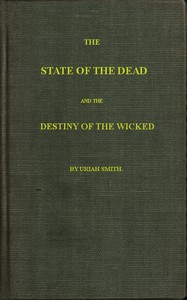
The state of the dead and the destiny of the wicked by Uriah Smith
Published in the late 1800s, Uriah Smith's book tackles one of the biggest questions humans have ever asked. Smith wasn't interested in poetry or philosophy on the topic. He wanted a clear, scriptural answer. The book is structured as a meticulous argument, examining what the Bible says—and doesn't say—about the condition of the dead and the ultimate fate of those judged as wicked.
The Story
There's no fictional plot here. The 'story' is the journey of Smith's investigation. He starts by looking at the common belief that people go to heaven or hell immediately after death. He asks: is that what the Bible actually teaches? He explores the Hebrew concept of 'Sheol' and the Greek 'Hades,' and argues that the dead are in an unconscious state, a 'sleep,' awaiting resurrection. The second major part of the book focuses on 'hell.' Smith challenges the idea of an eternally burning torture chamber. Instead, he presents a case from scripture that the punishment of the wicked is final, complete destruction—an annihilation—rather than endless suffering. The entire book is his evidence list, built verse by verse.
Why You Should Read It
You should read this not for easy answers, but for a rigorous mental workout. Even if you disagree with his conclusions (and many do), seeing how he constructs his argument is fascinating. Smith forces you to re-examine familiar passages. It's like watching a lawyer present a case, and you're the jury. The writing is from another era, so it's dense, but his passion is clear. This isn't a dry textbook; it's a persuasive essay from a man who genuinely believed the mainstream church had gotten a core doctrine terribly wrong. It makes you think, hard, about the very foundations of Christian afterlife belief.
Final Verdict
This book is perfect for curious readers, students of religious history, or anyone in a Bible study group tired of surface-level topics. It's especially relevant for those exploring Seventh-day Adventist theology, as Smith was a major influence. It is not for someone looking for a comforting, light read about heaven. Be ready to engage, to look up references, and to have your assumptions challenged. Think of it as the 19th-century equivalent of a deep-dive podcast series on a controversial topic—one that's still sparking debate today.
This text is dedicated to the public domain. It serves as a testament to our shared literary heritage.
James Harris
1 month agoHaving followed this topic for years, I can say that the practical checklists included are a great touch for real-world use. A mandatory read for anyone in this industry.
Charles Garcia
1 year agoComparing this to other titles in the same genre, the bibliography and references suggest a high level of research and authority. If you want to master this topic, start right here.
Christopher Thompson
5 months agoIt’s rare to find such a well-structured narrative nowadays, the case studies and practical examples provided add immense value. This is a solid reference for both beginners and experts.
Barbara Jones
8 months agoA must-have for graduate-level students in this discipline.




Paul Martinez
7 months agoIt’s rare to find such a well-structured narrative nowadays, it manages to maintain a consistent flow even when discussing difficult topics. I'm genuinely impressed by the quality of this digital edition.