1

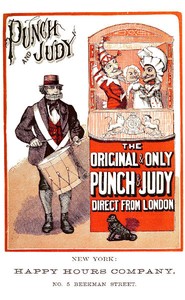
The tragical acts, or comical tragedies of Punch and Judy — Inside the Classic
(0 User reviews)
761
Project Gutenberg
2015
Not confirmed
Puppet plays; Punch and Judy
Readers of public-domain and historical texts
Project Gutenberg digital edition
en
Edition facts
Words
23,339
Reading time
102 min
Text sections
5
The catalog record for The tragical acts, or comical tragedies of Punch and Judy — Inside the Classic provides practical reading context through 23,339 words, 1 hr 42 min estimated reading time, and 5 detected text sections.
The text analysis averages about 13.3 words per sentence, while the detected sections provide another way to judge how the source is divided.
Project Gutenberg metadata also associates the work with “Puppet plays,” connecting these edition facts with the source record’s subject description.
Source:
Project Gutenberg record #48171
This 1879 edition of Punch and Judy combines a script for the traditional puppet show with historical essays on puppet-plays in Italy, England, and America, plus practical instructions for puppet construction and performance. George Cruikshank's illustrations anchor the volume, while the dialogue reveals a violent, farcical world far removed from children's entertainment.
Read the complete public-domain text at its original source.
Read on Project GutenbergGeorge Cruikshank's twenty-three illustrations are the most enduring feature of this 1879 edition, but the volume is far more than a picture book. It presents a full script for the Punch and Judy puppet show, preceded by essays on the origin of puppet-plays in Italy, their progress in England, and their antiquity in America, followed by instructions on constructing a theatre and manipulating the puppets. The catalog classifies the work under 'Puppet plays' and 'Punch and Judy,' yet the excerpts show a text that is part performance manual, part historical treatise, and part comedic script—a hybrid that resists easy categorization.
A Script Built on Repetition and Violence
The dialogue of the puppet show relies on a pattern of escalating physical abuse. In the excerpt featuring the Dutchman Schmidt, he is beaten repeatedly by a series of characters—Captain Blowhard, a Policeman, and others—each time for mistaken identity. The Policeman clubs him for bank robbery, then admits, 'you are not the man now, after all.' Schmidt's refrain, 'Yaw, another beefsteak,' turns each beating into a punchline. The humor depends on the audience's expectation of violence and the character's inability to escape it. This structural repetition, rather than plot development, drives the comedy.
Historical Claims vs. Textual Evidence
The catalog subjects 'Puppet plays' and 'Punch and Judy' suggest a straightforward presentation of the traditional show. However, the excerpts reveal a text that includes a lengthy historical introduction and practical instructions. The essay chapters claim to trace the origin of Punch in Italy and the progress of puppet-plays in England and America, but the excerpts do not provide evidence for these claims—only the chapter titles appear. The script itself, with its elaborate Dutchman sequence and characters like Mrs. Barrisnobe and the Lawyer, seems to expand far beyond the traditional Punch and Judy repertoire, mixing in elements of farce and mistaken identity that may reflect American stage adaptations rather than the Italian original.
The Role of the Illustrations and the 'Professor'
Cruikshank's illustrations are listed in detail, with titles like 'Punch and his Dog Toby' and 'Punch fights Old Nick,' but the excerpts do not describe them. The text is attributed to 'Prof. W.J. Judd,' a title that suggests authority, yet the content mixes scholarly pretension with broad comedy. The instructions on 'the Choice and Selection of Performing Figures' and 'the Management of the Punch Squeaker' imply a practical guide for performers, but the script itself is presented as literature. This tension between instruction and entertainment is central to the work's character.
Readers approaching this volume should be prepared for a work that defies modern expectations of a children's book. The violence is relentless and the humor is rooted in physical pain and ethnic stereotypes. The historical sections may be of interest to scholars of puppet theatre, but the script itself is best read as a period piece that reveals how nineteenth-century audiences understood comedy and performance.
I keep thinking about that old Punch and Judy book—how its raw, violent little world felt oddly honest, like a secret we weren’t meant to see. Something in its rawness reminded me of the quiet ache in Phaedra — Edition Insights, where passion also strips away pretense. Both linger because they refuse to soften their shadows, and that stays with you gently, like a half-remembered line.
There are no reviews for this eBook.
There are no comments for this eBook.
Reader reflection
Before you leave, reflect on the book
Use these questions to collect your thoughts before moving on.
Your progress
0
/
10
2
How did the book work for you overall?
3
How likely are you to recommend this book?
4
Did the language feel accessible?
5
Did the book deliver what you hoped for?
6
How understandable was the text?
7
Is this a title worth rereading?
8
Would this book work well in a reading group?
9
What did this book teach you most?
10