1

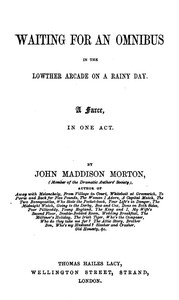
Waiting for an Omnibus in the Lowther Arcade on a Rainy Day: A Farce, in One Act — A Reader’s Guide
(0 User reviews)
2471
Project Gutenberg
2021
Not confirmed
London (England) -- Drama; English drama -- 19th century; Farces
Readers of public-domain and historical texts
Project Gutenberg digital edition
en
Edition facts
Words
12,079
Reading time
53 min
Text sections
5
This digital edition of Waiting for an Omnibus in the Lowther Arcade on a Rainy Day: A Farce, in One Act — A Reader’s Guide is described by source-level measurements including 12,079 words, 53 min estimated reading time, and 5 detected text sections.
The text analysis averages about 17.1 words per sentence, while the detected sections provide another way to judge how the source is divided.
Project Gutenberg metadata also associates the work with “London (England) -- Drama,” connecting these edition facts with the source record’s subject description.
Source:
Project Gutenberg record #65255
A one-act farce set in London's Lowther Arcade, where a rainy day traps a cast of scheming characters—including a tailor, a jealous suitor, and a woman with a secret—amid mistaken identities and comic misunderstandings.
Read the complete public-domain text at its original source.
Read on Project GutenbergThe play opens with a stage direction that immediately establishes its setting: the interior of the Lowther Arcade, with the Strand entrance at left, shops and stalls across the back, and a crowd of pedestrians, some with umbrellas, while heavy rain is heard. This is not a mere backdrop; the arcade becomes a character in itself, a confined space where chance encounters and comic collisions are inevitable. The first lines, spoken by Mrs. Jellicoe as she forces her way through the crowd, set a tone of bustling impatience: 'Mercy on us! here's a day! this is something like rain.' Her daughter Fanny's dry reply—'Yes, mamma, very like it indeed'—hints at the verbal sparring that will follow.
A Confined Stage for Comic Collisions
The Lowther Arcade, as described in the opening stage directions, is a covered shopping arcade, a real London landmark of the period. Morton uses this setting to create a pressure cooker of social interactions. The stage is crowded with pedestrians, including a Beadle who occasionally appears, and characters enter and exit through the single Strand entrance. This physical constraint forces characters into close proximity, heightening the farcical potential. The rain, heard throughout, traps everyone inside, making the arcade a temporary prison where secrets and schemes inevitably surface. The play's title itself—Waiting for an Omnibus in the Lowther Arcade on a Rainy Day—underscores the mundane yet frustrating situation that sets the plot in motion.
Verbal Duels and Repetitive Patterns
Morton's dialogue relies heavily on repetition and echo for comic effect. For instance, when O'Walker and Patty Peckover reunite, their exchange follows a pattern of accusation and denial: O'Walker recalls 'Greenwich in the morning' and 'Vauxhall in the evening,' each met with Patty's horrified repetition of the place name. This technique, reminiscent of Morton's earlier farce Box and Cox, creates a rhythmic, almost musical quality. Another recurring device is the use of convoluted explanations, as when O'Walker describes how he knows about the letters: 'the gentleman is the friend of an intimate friend of a friend of mine.' Such lines mock the absurdity of gossip and secondhand knowledge, a theme that runs through the play.
Character as Type and Individual
The dramatis personae list reveals stock farcical types: O'Walker, the scheming protagonist; Brown, the jealous suitor; Schnipps, the tailor; and the Beadle, a figure of authority. Yet Morton gives each a distinctive voice. O'Walker's speech is peppered with exclamations and asides, like 'Goodness gracious! Dibbs! I quite forgot Dibbs.' Brown's melodramatic threats—'sweep him off the surface of the earth'—are undercut by his physical description as a man of 'protuberant proportions.' Patty Peckover, a former sweetheart now married to a soap magnate, delivers sharp retorts: 'when you behaved like a brute to me—yes, Mr. O'Walker, brute's the word.' These characters are not fully developed but are vividly drawn through their dialogue and actions.
The Farce of Misinformation and Mistaken Identity
The plot, as far as the excerpts reveal, hinges on a series of misunderstandings and deliberate deceptions. O'Walker sends Brown to retrieve letters from a woman named Amelia Jones, hoping to expose a rival. The letters are hidden in a drawer, and Brown is instructed to 'pounce down upon them.' Meanwhile, O'Walker encounters Patty, who is engaged to a man identified only as 'B. B.'—a detail that may lead to confusion with Brown himself. The play's humor derives from characters acting on incomplete or false information, a staple of farce. The excerpts do not reveal the resolution, but the pattern of mistaken identity and comic timing suggests a tidy, if improbable, ending.
Readers approaching this farce should pay close attention to the stage directions, which are integral to the comedy. The rain, the crowded arcade, and the characters' physical movements—such as O'Walker opening his umbrella and polking with it—are as important as the dialogue. The play is short, designed for a fifty-minute performance, and moves at a brisk pace. Morton's skill lies in creating a self-contained world where every line and gesture contributes to the farcical effect. Enjoy the verbal sparring and the absurdity of human behavior under pressure.
I have long loved that farce in the Lowther Arcade—how its schemers mistake each other's shadows for substance. Years later, I found the same gentle foolishness in Poker! — Context and Discussion, where bluff and tells mirror those rainy-day masks. Both feel like old friends whispering that we are all, perhaps, just playing our parts until the sun breaks through.
There are no reviews for this eBook.
There are no comments for this eBook.
Reader reflection
Before you leave, reflect on the book
Use these questions to collect your thoughts before moving on.
Your progress
0
/
10
2
Was reading this book enjoyable?
3
How likely are you to recommend this book?
4
How demanding did the text feel?
5
How much did the book move you?
6
How strong was your personal connection to the text?
7
Could you apply anything you learned?
8
How would you rate its originality?
9
Which lesson or insight stayed with you?
10