1

William Shakespeare — Reading Notes
(0 User reviews)
518
Project Gutenberg
2016
Not confirmed
Shakespeare, William, 1564-1616; Dramatists, English -- Early modern, 1500-1700 -- Biography; Stratford-upon-Avon (England) -- Biography
Readers of public-domain and historical texts
Project Gutenberg digital edition
en
Edition facts
Words
103,660
Reading time
451 min
Text sections
11
Before opening William Shakespeare — Reading Notes, the edition data offers a quick orientation: 103,660 words, 7 hr 31 min estimated reading time, and 11 detected text sections.
The text analysis averages about 16.9 words per sentence, while the detected sections provide another way to judge how the source is divided.
Project Gutenberg metadata also associates the work with “Shakespeare, William, 1564-1616,” connecting these edition facts with the source record’s subject description.
Source:
Project Gutenberg record #53490
Victor Hugo's 1864 book on Shakespeare is a passionate, poetic essay that uses the playwright as a springboard to explore art, genius, and civilization. Hugo's own voice dominates, blending biography with rhapsodic criticism.
Read the complete public-domain text at its original source.
Read on Project GutenbergVictor Hugo's William Shakespeare (1864) is less a biography than a manifesto. The preface announces its true title as "Apropos to Shakespeare," and the book proceeds to treat Shakespeare as a catalyst for Hugo's own theories on art, genius, and human progress. The catalog subjects—Shakespeare's life, English dramatists, Stratford—are present only in the first book; the bulk of the work ranges across Homer, Job, Æschylus, Dante, Rabelais, and Cervantes, using them to define a hierarchy of genius. Hugo's prose is oratorical, dense with metaphor: Shakespeare is a "bottomless treasury," a "condor," a poet who "decants all Nature, drinks it, and makes you drink it." The reader should expect a Romantic polemic, not a scholarly life.
Hugo's Shakespeare: A Portrait by Exaggeration
Hugo's method is to magnify. He describes Shakespeare's language as having "the sharp perfume of honey made by the vagabond bee without a hive." The playwright's drama "proceeds with a kind of distracted rhythm" and "staggers" because it is so vast. Hugo insists that Shakespeare "shudders at his own depth" and that "there is no genius without waves." These are not observations drawn from the plays themselves; they are Hugo's own Romantic ideal of the artist as a force of nature. The excerpts contain no direct quotation from Shakespeare's works—only Hugo's rhapsodic paraphrases. The reader should note that Hugo's Shakespeare is a construct, a mirror for Hugo's own aesthetic.
The Structure: From Biography to Cosmic Taxonomy
The book's table of contents reveals a peculiar architecture. Part I, Book I is titled "Shakespeare.—His Life," but the excerpts show that even this section begins with a description of Hugo's own house on a winter evening, not with Shakespeare's birth. The subsequent books abandon biography entirely: "Men of Genius" lists Homer, Job, Æschylus, Isaiah, Ezekiel, Lucretius, Juvenal, Tacitus, St. John, St. Paul, Dante, Rabelais, Cervantes, and Shakespeare. Part II includes chapters on "Zoilus as Eternal as Homer" and "The Minds and the Masses." The catalog subject "letters-speeches" is apt: the book is a series of orations. Hugo's organizing principle is not chronological but hierarchical, placing Shakespeare at the summit of a pantheon of "supreme spirits."
The Translator's Role and the English Address
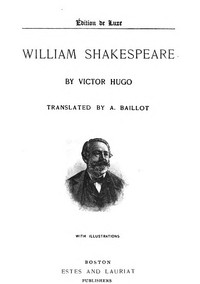
The title page credits A. Baillot as translator, and the book is dedicated "TO ENGLAND" with the line: "I TELL ENGLAND THE TRUTH; BUT, AS A LAND ILLUSTRIOUS AND FREE, I ADMIRE HER, AND AS AN ASYLUM. I LOVE HER." This dedication, dated Hauteville House, 1864, frames the work as a political as well as literary gesture. Hugo, then in exile from France, positions himself as a truth-teller to a nation he admires. The translation itself is ornate, preserving Hugo's long sentences and exclamatory tone. The reader should be aware that the English text is a rendering of Hugo's French, not a direct study of Shakespeare's English. The book's style—with its rhetorical questions, apostrophes, and sweeping claims—is characteristic of Hugo's polemical writing.
Readers approaching this book should set aside expectations of a conventional biography or critical study. Hugo's William Shakespeare is a work of Romantic self-projection, in which the playwright becomes a symbol for the power of art to advance civilization. The most useful approach is to read it alongside Hugo's own novels and poems, noting the parallels in style and theme. The catalog subjects are a starting point, but the book's true subject is Victor Hugo's vision of genius.
There are evenings when Hugo’s torrent on Shakespeare feels less like criticism and more like a storm one is glad to be indoors for. That hunger for a single, stubborn voice—it lingers. I found something of that same solitary pulse in Where There is Nothing Being Volume I of Plays for an Irish Theatre — Edition Insights, though the weather there is quieter, more a coastal mist than a tempest.
There are no reviews for this eBook.
There are no comments for this eBook.
Reader reflection
What was your reading experience?
Capture what you thought, learned, and would like to remember.
Your progress
0
/
10
2
Did this book hold your interest?
3
Would you encourage someone else to read it?
4
How easy was the book to follow?
5
How closely did the book connect with your experience?
6
Did any part of the book stay with you emotionally?
7
Which part made the strongest impression?
8
How would you describe its reading pace?
9
What did this book teach you most?
10