1

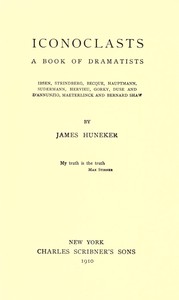
Iconoclasts: A Book of Dramatists Ibsen, Strindberg, Becque, Hauptmann, Sudermann, Hervieu, Gorky, Duse and D'Annunzio, Maeterlinck and Bernard Shaw — Reading Notes
(0 User reviews)
391
Project Gutenberg
2014
Not confirmed
Dramatists; European drama -- 19th century -- History and criticism; European drama -- 20th century -- History and criticism
Readers of public-domain and historical texts
Project Gutenberg digital edition
en
Edition facts
Words
106,409
Reading time
463 min
Text sections
9
The source record for Iconoclasts: A Book of Dramatists Ibsen, Strindberg, Becque, Hauptmann, Sudermann, Hervieu, Gorky, Duse and D'Annunzio, Maeterlinck and Bernard Shaw — Reading Notes measures this digital text at 106,409 words, 7 hr 43 min estimated reading time, and 9 detected text sections.
The text analysis averages about 18.3 words per sentence, while the detected sections provide another way to judge how the source is divided.
Project Gutenberg metadata also associates the work with “Dramatists,” connecting these edition facts with the source record’s subject description.
Source:
Project Gutenberg record #47546
James Huneker's 1905 collection of essays on European dramatists, including Ibsen, Strindberg, and Shaw, examines their iconoclastic spirit through detailed analysis of key plays, emphasizing soul drama and technical innovation.
Read the complete public-domain text at its original source.
Read on Project GutenbergJames Huneker opens his study of Henrik Ibsen by invoking Ferdinand Brunetière's definition of tragedy as a struggle where 'something other and greater than life is at stake.' This framing immediately establishes the book's critical method: each dramatist is measured against the intensity of their spiritual and ethical conflicts. Huneker's prose is dense with allusion and metaphor—Ibsen becomes 'an open door' through which we view 'the struggle of souls in pain and doubt and wrath.' The reader should expect not a survey but a series of passionate, opinionated essays that treat plays as battlegrounds for ideas.
The Individualist Lens
Huneker's first chapter, 'Henrik Ibsen: The Individualist,' sets the tone for the entire volume. He argues that Ibsen's dramas are 'first soul dramas,' with the human soul as 'the stake for which his characters breathlessly game.' This is not a neutral introduction; Huneker is already taking sides, praising Ibsen's 'technical genius' while acknowledging accusations of anarchic preaching. The reader will notice how Huneker uses recurring symbols—doors, missing walls—to link Ibsen's stagecraft to his philosophy. He quotes Ibsen's own remark that the stage should be 'a room with the fourth wall knocked down,' then adds his own gloss: 'A tragic wall is this missing one.' This blend of quotation and personal interpretation is Huneker's signature.
Gallic Logic and the Well-Made Play
In the chapter on Paul Hervieu, Huneker shifts from Scandinavian symbolism to French rationalism. He dissects The Enigma (also known as Cæsar's Wife), noting its 'long-winded discussions à la Dumas' and the presence of a raisonneur who turns the first act into 'a debating society.' Huneker is critical of Hervieu's 'too logical, too Gallic' approach, wishing the playwright had 'ended on an unresolved cadence' like Ibsen. Yet he also praises the play's 'tremendous indictment of the man who slays the woman on the plea of outraged honour.' The reader sees Huneker weighing form against content: he admires technical daring but demands moral complexity.
The Quartet and the Unknown Quantity
Huneker's plot summary of The Enigma reveals his storytelling skill. He describes a 'quartet instead of the eternal duo with the triangle hung over the door like a sinister horseshoe.' The two brothers, 'mighty Nimrods,' are 'absolutely lacking in humour,' while the young man Vivarce is 'the unknown quantity of this well-mixed combination.' Huneker's language is vivid and slightly sardonic: the brothers 'love their wives better, much better, than their dogs.' This passage shows how Huneker uses concrete details—the gamekeeper's report of poachers, the early-morning hunt—to ground his critical observations. He never loses sight of the play's mechanics even as he judges its ideas.
A Critic's Voice
Throughout Iconoclasts, Huneker's own personality is unmistakable. He refers to having seen performances ('Paul Mounet was excellent'), compares plays across national traditions, and does not hesitate to call a title 'pompous.' His judgments are sharp: Hervieu's Les Paroles Restent is dismissed for 'wordiness.' Yet he also acknowledges the difficulty of the playwright's task, noting that 'in their revolt against the so-called "well-made play," the newer Parisian dramatists have gone to the other extreme.' The reader should watch for these moments of balance—Huneker is never merely a partisan. He is a critic who demands that drama engage with 'something other and greater than life,' but he also knows that the stage must hold an audience.
Huneker's Iconoclasts rewards readers who approach it as a series of intellectual encounters rather than a systematic history. Each essay stands alone, yet together they build a portrait of European drama at a moment of radical change. The reader is advised to start with the dramatists they know least: Huneker's enthusiasm is most infectious when he is introducing unfamiliar work. His prose demands attention—every sentence carries weight—but the effort is repaid by insights that still feel fresh more than a century later.
Holding Huneker’s Iconoclasts, I remembered sitting up late with Strindberg’s corrosive dialogues, feeling that strange comfort of chaos given shape. That same quiet ache returned with Professor Tim & Paul Twyning — Context and Discussion, where the margins felt like a conversation I’d once had alone. Books that argue with themselves leave a particular warmth behind.
There are no reviews for this eBook.
There are no comments for this eBook.
Reader reflection
Before you leave, reflect on the book
Use these questions to collect your thoughts before moving on.
Your progress
0
/
10
2
How did the book work for you overall?
3
Would you recommend this book to another reader?
4
Did the language feel accessible?
5
Did the book offer a fresh perspective?
6
Which part made the strongest impression?
7
How did the pace of the book feel?
8
Would you start a conversation about this book?
9
What did this book teach you most?
10