1

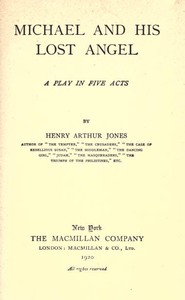
Michael and His Lost Angel: A Play in Five Acts — A Closer Reading
(0 User reviews)
324
Project Gutenberg
2014
Not confirmed
English drama; Adultery -- Drama; England -- Social life and customs -- 20th century -- Drama; Clergy -- Drama
Readers of public-domain and historical texts
Project Gutenberg digital edition
en
Edition facts
Words
34,001
Reading time
148 min
Text sections
9
The source record for Michael and His Lost Angel: A Play in Five Acts — A Closer Reading measures this digital text at 34,001 words, 2 hr 28 min estimated reading time, and 9 detected text sections.
The text analysis averages about 11.3 words per sentence, while the detected sections provide another way to judge how the source is divided.
Project Gutenberg metadata also associates the work with “English drama,” connecting these edition facts with the source record’s subject description.
Source:
Project Gutenberg record #47331
Henry Arthur Jones's five-act play traces a clergyman's internal conflict between religious duty and a forbidden attachment, using repeated images of rowing, blistered hands, and celestial judgment to chart his moral descent.
Read the complete public-domain text at its original source.
Read on Project GutenbergThe play opens not with a dramatic confrontation but with a quiet, almost clerical detail: Michael Feversham, a clergyman, shows his blistered hands to Audrie Lesden, ruefully admitting, “I’m not used to rowing.” That small, physical confession sets the pattern for a drama in which bodily evidence—hands, gestures, glances—carries the weight of unspoken transgression. Jones builds the entire first act around the couple’s careful reconstruction of their alibi, a scene that functions less as exposition than as a shared ritual of self-deception. The dialogue moves in short, hesitant exchanges, punctuated by pauses and stage directions that emphasize what is not said. Michael’s later remark about “the High Court where such cases are tried” introduces a recurring structural device: the sense of an invisible tribunal, whether divine or social, that will eventually demand an accounting.
The Architecture of Guilt: Five Acts as Five Stages
Jones divides the play into five acts, each corresponding to a phase in Michael’s moral trajectory. The first act establishes the secret and its immediate cover-up; the second deepens the entanglement; the third brings exposure; the fourth forces a reckoning; the fifth offers a kind of resolution. This classical structure is reinforced by the author’s note, which lists each act and scene with a brief description, giving the whole a deliberate, almost architectural feel. The symmetry is not merely formal: the opening scene’s careful alibi-making finds its echo in later scenes where characters again rehearse explanations, each time with less conviction. The five-act division also allows Jones to shift settings—from Michael’s study to a seaside chapel to a London drawing-room—so that each change of place marks a change in the characters’ moral geography. The play’s movement is not linear but circular, returning again and again to the same questions of truth, shame, and the impossibility of return.
Rowing, Hands, and the Weight of the Body
Two images recur with unusual precision: rowing and blistered hands. Michael’s hands are mentioned in the first act and again later, a physical mark of his unaccustomed labor. The rowing itself—the act of crossing water to meet Audrie—becomes a metaphor for the transgressive journey. Jones does not let the image remain abstract; he grounds it in the body. Michael is not used to rowing, and his body registers the strain. This attention to physical detail extends to other moments: the way characters stand, the length of a pause, the direction of a glance. The stage directions are unusually full, specifying not just who enters but how they move and what they carry. In a play about spiritual crisis, Jones insists on the material world—the weight of a hand, the ache of a muscle—as the site where moral choices are felt. The blistered hands are not a symbol; they are evidence.
The Unheard Opening and the Problem of Reception
Joseph Knight’s preface, included in this edition, offers a rare glimpse into the play’s troubled first performance. Knight reports that the opening scene—which he calls “the very raison-d’être of the play”—was drowned out by late arrivals, so that “the nature of Michael Feversham’s offence and the value of his expiation were both partially misunderstood.” This is not merely a piece of theatrical history; it points to a structural vulnerability in the play itself. Jones front-loads essential information into a quiet, intimate exchange that depends on the audience’s full attention. Without that scene, the rest of the drama risks seeming unmotivated. Knight’s preface thus functions as a kind of defensive reading, arguing that the play’s failure was not artistic but accidental. Whether or not one accepts that argument, the preface makes visible the gap between the play as written and the play as heard—a gap that any reader must now negotiate.
Dialogue as Duel: The Rhythm of Confession and Withdrawal
Jones’s dialogue moves in a distinctive pattern: short, overlapping lines, frequent pauses, and a tendency for characters to interrupt themselves or each other. In the first act, Michael and Audrie’s exchange about the alibi is a model of this technique. They speak in fragments, finishing each other’s sentences, circling around the unspeakable. The stage directions mark every hesitation: “(Pause.)”, “(Very tenderly.)”, “(With an inclination of the head and finger towards heaven.)”. These are not mere cues for actors; they are part of the play’s meaning. The characters are always on the verge of saying too much or too little. Michael’s repeated “Hush!” and “You mustn’t speak like this” are not just moral scruples; they are attempts to control the flow of speech itself. The play’s tension comes not from what is said but from the constant threat that someone will break the fragile decorum of their shared fiction.
Readers coming to this play should attend closely to the stage directions, which carry as much dramatic weight as the dialogue. The preface by Joseph Knight offers a contemporary defense of the work, but it is not a neutral guide; it is itself a document of the play’s contested reception. Jones’s language is spare, his scenes carefully built, his images—rowing, hands, the “High Court” of heaven—repeated with a precision that rewards attention. The play does not explain its characters’ motives; it shows them in the act of failing to explain themselves.
That rainy afternoon, I kept thinking about Michael’s blistered hands—how devotion leaves its own scars. Jones’s play felt so heavy with celestial judgment, I set it aside. Later, almost without thinking, I picked up Heartbreak House — A Reader’s Guide. Where Michael drowns in guilt, Shaw’s characters simply drift, and that contrast felt like a quiet exhale.
There are no reviews for this eBook.
There are no comments for this eBook.
Reader reflection
Take a moment to reflect on this book
Create a short personal record of your experience with this book.
Your progress
0
/
10
2
How did the book work for you overall?
3
Is this a title you would suggest to others?
4
How easy was the book to follow?
5
How useful did the reading feel?
6
Which aspect of the book did you value most?
7
How strong was your personal connection to the text?
8
Did anything about the book feel genuinely new?
9
What did this book teach you most?
10