1

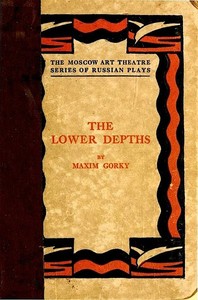
The Lower Depths: A Drama in Four Acts — Inside the Classic
(0 User reviews)
357
Project Gutenberg
2016
Not confirmed
Russian drama -- Translations into English; Russia -- Social conditions -- 1801-1917 -- Drama; Poverty -- Russia -- Drama; Poverty -- Moral and ethical aspects -- Drama
Readers of public-domain and historical texts
Project Gutenberg digital edition
en
Edition facts
Words
29,155
Reading time
127 min
Text sections
7
The source record for The Lower Depths: A Drama in Four Acts — Inside the Classic measures this digital text at 29,155 words, 2 hr 7 min estimated reading time, and 7 detected text sections.
The text analysis averages about 10.7 words per sentence, while the detected sections provide another way to judge how the source is divided.
Project Gutenberg metadata also associates the work with “Russian drama -- Translations into English,” connecting these edition facts with the source record’s subject description.
Source:
Project Gutenberg record #52468
In Gorky's four-act drama, the inhabitants of a Russian night-lodging house reveal their lives through fragmented stories and bitter humor. The play's power lies not in plot but in the interplay of voices, where truth and lies blur, and the weight of poverty is felt in every pause and gesture.
Read the complete public-domain text at its original source.
Read on Project GutenbergGorky's The Lower Depths opens not with a grand statement but with the cramped, dim interior of a cellar lodging, where the characters are introduced through their actions and snatches of conversation rather than formal exposition. The play's structure—four acts set entirely in this single, oppressive space—forces the audience to focus on the inhabitants' voices: the prostitute Nastya's romantic fantasies, the Baron's mocking laughter, the cobbler Alyoshka's drunken songs. The editor Oliver M. Sayler, in his introduction, emphasizes that the play's effect in performance depends on "the intangible flow of human souls in endlessly shifting contact with one another," a quality that the printed text can only partially convey.
Voices in the Cellar: Speech as Action
The excerpt from Act One demonstrates how Gorky builds drama almost entirely through dialogue and its interruptions. When Nastya recounts her fabricated love affair with a French student named Gaston, the other lodgers react with a mix of mockery and grudging attention. The Baron points out that last time the lover was called Raoul; Bubnov laughs and calls her a "limb of Satan." Yet Luka, the elderly pilgrim, defends her: "it isn't the word that matters, but what's in back of the word." This exchange reveals a central technique: characters use stories not to convey facts but to assert their dignity or to wound. The stage directions—"jumping up," "covers her face with her hand and weeps gently"—are as crucial as the lines, indicating that the emotional weight lies in the pauses and gestures between speeches.
The Catalog Subjects and the Play's Actual Concerns
The Project Gutenberg catalog lists subjects such as "Poverty -- Moral and ethical aspects -- Drama" and "Russia -- Social conditions -- 1801-1917 -- Drama." While poverty is the material condition of every character, the excerpts show that the play is less concerned with moralizing about poverty than with the psychological strategies people use to endure it. Nastya's invented romance, Natasha's hope that "to-morrow somebody will really appear," and the Baron's cynical dismissal of expectation all point to a shared need for illusion. The characters do not debate ethics; they argue about whose story is true. Luka's line—"If you believe you had a real love affair, then you did"—suggests that the play treats belief itself as a form of survival, not a moral failing. The catalog's emphasis on "moral and ethical aspects" may mislead readers expecting a didactic critique; instead, Gorky presents a world where morality is a luxury the poor cannot afford.
The Role of Luka: Comfort Without Resolution
Luka, the old wanderer, appears in the excerpt as a figure of gentle authority, stroking Nastya's head and urging the others to "show a little respect." His function is not to solve problems but to offer temporary solace. When Nastya weeps, he takes her hand and says, "Come, dear! It's nothing! Don't be angry—I know—I believe you!" This is not a lie but a deliberate suspension of disbelief. The Baron and Bubnov, by contrast, represent a harsh realism that offers no comfort. The play does not endorse either position; instead, it dramatizes the tension between the need for illusion and the corrosive effect of truth. Luka's kindness is genuine, but it changes nothing about the characters' material conditions. The excerpt ends with him leading Nastya away, leaving the others to their barren arguments. This pattern—comfort followed by a return to squalor—suggests that the play's structure is cyclical, not progressive.
Readers approaching The Lower Depths should attend to what is not said: the silences, the interruptions, the moments when a character trails off. Gorky's drama resists summary because its meaning resides in the accumulation of small, contradictory gestures. The play's reputation as a masterpiece of the Moscow Art Theatre rests on its ability to make a single room feel like a universe. To read it is to listen for the echoes between the lines.
That gray afternoon, the lodgers’ bitter laughter in The Lower Depths clung to me like damp wool—their proud lies against poverty’s weight. Later, restless, I found myself drifting to an old American collection where a Revolutionary-era courtship hummed with the same stubborn dignity, though in brighter clothes. Representative Plays by American Dramatists: 1856-1911: Love in '76 An Incident of the Revolution — A Reader’s Guide somehow rhymed with Gorky’s shadows, a quieter echo I hadn’t expected.
There are no reviews for this eBook.
There are no comments for this eBook.
Reader reflection
Record your reading impressions
A brief reflection can help important ideas stay with you longer.
Your progress
0
/
10
2
How did the book work for you overall?
3
Would you pass this book on to a friend?
4
Did the language feel accessible?
5
Is this a title worth rereading?
6
How well did it match your expectations?
7
Was the book moving at the right speed?
8
How strongly did the book affect you emotionally?
9
What changed or sharpened your thinking?
10