1

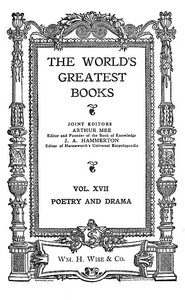
The World's Greatest Books — Volume 17 — Poetry and Drama — Reading Notes
(0 User reviews)
583
Project Gutenberg
2014
Not confirmed
Poetry; Drama
Readers of public-domain and historical texts
Project Gutenberg digital edition
en
Edition facts
Words
99,829
Reading time
435 min
Text sections
17
This digital edition of The World's Greatest Books — Volume 17 — Poetry and Drama — Reading Notes is described by source-level measurements including 99,829 words, 7 hr 15 min estimated reading time, and 17 detected text sections.
The text analysis averages about 14.1 words per sentence, while the detected sections provide another way to judge how the source is divided.
Project Gutenberg metadata also associates the work with “Poetry,” connecting these edition facts with the source record’s subject description.
Source:
Project Gutenberg record #44640
This editorial note examines the editorial framing of poetry and drama in a 1910s anthology, focusing on how abridgments and introductory summaries shape reader expectations. Observations are drawn from the volume's treatment of Goethe's 'Goetz von Berlichingen' and Jonson's 'Every Man in His Humour'.
Read the complete public-domain text at its original source.
Read on Project GutenbergThe volume presents condensed versions of canonical plays and poems, each prefaced by a synopsis that often foregrounds plot mechanics over stylistic texture. In Goethe's Goetz von Berlichingen, the editorial summary reduces the drama to a straightforward conflict between the knight and the bishop, while the excerpt itself reveals a more layered opening: Goetz's restless waiting, his terse commands to George, and the offstage galloping of horses create a tense, sensory atmosphere that the synopsis flattens. Similarly, Jonson's Every Man in His Humour is introduced as a comedy of humours, yet the selected scene—Knowell intercepting a letter, Bobadill boasting about swordplay—shows how Jonson builds character through specific, quirky speech patterns rather than abstract types.
Abridgment and the Loss of Dramatic Rhythm
The editorial method in this anthology is to excerpt key scenes and wrap them in a prose summary that explains the omitted action. For Goetz von Berlichingen, the synopsis tells us that Goetz ambushes Weislingen, but the excerpt itself dwells on the waiting: Goetz's repeated calls for George, his mention of five days and nights in ambush, and the sound of galloping horses. This pacing—the tension before the ambush—is the dramatic rhythm, and it is largely absent from the editorial frame. The same occurs in Jonson: the summary notes that Knowell intercepts a letter, but the excerpt's comedy lies in the precise wording of that letter—'Leave thy vigilant father alone, to number over his green apricots'—and in Brain-Worm's sly report that Knowell 'read the contents.' The editorial note cannot reproduce the timing of these revelations.
Character Through Idiosyncratic Speech
Both plays rely on distinctive voices to define character, a feature the editorial summaries tend to generalize. In Goetz von Berlichingen, Goetz's language is blunt and imperative: 'Tell Hans to get ready. My scouts may be back any moment. And give me some more wine!' His wife Elizabeth speaks in a contrasting register—'Thank God, I am made of harder stuff!'—which the synopsis reduces to a note on her loyalty. In Jonson, Bobadill's speech is a tissue of affectations: 'by the heart of valour in me,' 'some peculiar and choice spirit,' and his plan to 'have a bunch of radish and salt to taste our wine.' The editorial summary calls him a 'braggart captain,' but the excerpt shows how his bravado is built from specific, ridiculous details—the radish, the two shillings, the promise of a 'staccato' kill. These verbal tics are the humour, not the plot.
The Editorial Voice as Intermediary
The anthology's editorial apparatus consistently mediates between reader and text. Each play is introduced by a paragraph that states its 'theme' or 'moral'—for Goetz, the conflict between knightly honour and imperial authority; for Every Man in His Humour, the exposure of affectation. Yet the excerpts themselves resist such neat framing. Goetz's opening speech is not about honour but about personal vengeance: 'But when I get thee, Weislingen, I shall make up for it!' Jonson's scene ends not with a moral but with Bobadill's absurd plan to 'chartel' Down-right. The editorial summaries thus impose a coherence that the dramatic fragments do not fully support. Readers encountering only these excerpts may find the plays more ambiguous and less didactic than the introductions suggest.
This volume is best approached as a sampler of dramatic moments rather than a guide to complete works. The editorial summaries offer context, but the excerpts themselves reward attention to tone, pacing, and verbal detail—the elements that abridgment necessarily compresses. Readers interested in the full shape of either play should seek complete texts; the anthology's value lies in the contrasts it enables between different dramatic styles and periods.
There’s something touching about how these old editors trimmed Goetz into a shape meant to be manageable, not mighty. It makes me think of the quieter pleasure in Caesar and Cleopatra — A Closer Reading, where the seams show too, but in a way that feels almost like company. I miss that patient, imperfect closeness.
There are no reviews for this eBook.
There are no comments for this eBook.
Reader reflection
Record your reading impressions
A brief reflection can help important ideas stay with you longer.
Your progress
0
/
10
2
How did the book work for you overall?
3
Would you recommend this book to another reader?
4
Did the language feel accessible?
5
Was the book what you thought it would be?
6
Did you relate to its people, ideas, or situations?
7
Could you follow the author’s main argument?
8
Did anything about the book feel genuinely new?
9
What did this book teach you most?
10