1

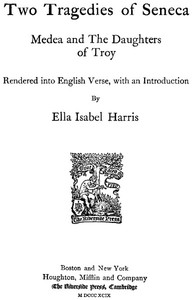
Two Tragedies of Seneca: Medea and The Daughters of Troy Rendered into English Verse — A Reader’s Guide
(0 User reviews)
1468
Project Gutenberg
2014
Not confirmed
Trojan War -- Drama; Medea, consort of Aegeus, King of Athens (Mythological character) -- Drama; Hecuba, Queen of Troy -- Drama; Seneca, Lucius Annaeus, approximately 4 B.C.-65 A.D. -- Translations into English
Readers of public-domain and historical texts
Project Gutenberg digital edition
en
Edition facts
Words
23,941
Reading time
105 min
Text sections
5
For Two Tragedies of Seneca: Medea and The Daughters of Troy Rendered into English Verse — A Reader’s Guide, the stored edition analysis reports 23,941 words, 1 hr 45 min estimated reading time, and 5 detected text sections.
The text analysis averages about 19.4 words per sentence, while the detected sections provide another way to judge how the source is divided.
Project Gutenberg metadata also associates the work with “Trojan War -- Drama,” connecting these edition facts with the source record’s subject description.
Source:
Project Gutenberg record #46058
Ella Isabel Harris's 1899 verse translation of Seneca's Medea and The Daughters of Troy, with an introduction tracing Senecan influence on English drama. The edition pairs two tragedies of vengeance and ruin, revealing stark contrasts in their treatment of grief, agency, and the aftermath of war.
Read the complete public-domain text at its original source.
Read on Project GutenbergElla Isabel Harris's 1899 verse translation of Seneca's Medea and The Daughters of Troy opens with an introduction that situates these plays within a larger literary history: the Senecan influence on English drama. Harris argues that while French drama was 'overmastered' by Seneca, the English spirit 'remained distinctively English,' absorbing Senecan elements as 'formative rather than dominant.' This framing invites readers to approach the two tragedies not as isolated artifacts but as works that shaped the evolution of the serious stage. The translation itself, rendered in English verse, preserves the rhetorical intensity of Seneca's originals while making them accessible to students of drama. The volume pairs two plays that, though separated by mythic setting, share a preoccupation with catastrophic aftermaths: Medea's calculated vengeance and the collective grief of Troy's fallen women.
Rhetorical Structures of Lament
In The Daughters of Troy, grief is orchestrated through formal, antiphonal exchanges. Hecuba commands her followers: 'lift thy hand / And beat upon thy breast' (lines 82–83), and the Chorus responds with precise physical actions—unbinding hair, strewing ashes, baring shoulders. This call-and-response pattern, marked by repeated refrains like 'We weep for Hector,' transforms personal sorrow into a ritualized public performance. The language is measured, almost liturgical: 'O sorrow, show thy power; let Rhœta's shores / Give back the blows' (lines 100–101). Harris's verse captures the controlled cadence of Seneca's original, where emotion is channeled through formal structures rather than spontaneous outbursts. The effect is one of collective endurance, a community bound by shared rites of mourning.
Contrasting Fates: Priam and Hector
Hecuba's lament distinguishes sharply between the deaths of Hector and Priam. Hector is mourned as 'the pillar of thy land, her fates' delay, / The prop of wearied Phrygians, and the wall / Of Troy' (lines 111–113). His fall is synonymous with the city's collapse: 'With thee thy country fell.' Priam, by contrast, is declared 'thrice happy' because he died a king, 'free he descended to the land of shades,' never to bear 'the Grecian yoke' (lines 130–131). The Chorus echoes this judgment, calling Priam 'happy' who 'wanders now / Through the safe shadows of Elysian Fields' (lines 141–142). This valuation of death over enslavement introduces a stark moral calculus: for Seneca's Trojans, a king's dignified end outweighs a warrior's heroic sacrifice. The play thus weighs different modes of loss, measuring grief against the prospect of captivity.
The Translator's Historical Frame
Harris's introduction, though brief, establishes a critical lens for reading the plays. She traces Senecan influence through the sixteenth century, noting that Thomas Newton's 1581 collection Seneca his Ten Tragedies made these works available in English. Her own translation, she states, was undertaken 'in the hope that they may be found useful to English students of English drama.' This pedagogical aim shapes the volume's tone: the verse is clear and declamatory, suited for study rather than performance. The introduction also highlights a key tension: Seneca's tragedies were 'formative' for English drama, but the native tradition 'remained distinctively English.' Readers are thus encouraged to see these plays as both artifacts of Roman literature and active agents in the development of the modern stage—a dual identity that informs every scene of vengeance and lament.
Readers approaching these two tragedies will find them best read in tandem, as each illuminates the other's treatment of catastrophe. Medea presents vengeance as a solitary, calculating act; The Daughters of Troy shows grief as a communal, ritualized response. Harris's translation, with its formal verse and historical framing, invites attention to the rhetorical structures that Seneca uses to explore these extremes. Pay particular attention to the choral odes and the interplay between individual and collective voices—these are the engines of Senecan tragedy.
I have often thought Seneca’s Medea and The Daughters of Troy speak to one another across the centuries—both haunted by what revenge cannot restore. That same quiet ache lingers in Scorn of Women: A Play In Three Acts — A Reader’s Guide, where pride and grief wear modern faces, yet the old wounds remain familiar.
There are no reviews for this eBook.
There are no comments for this eBook.
Reader reflection
Take a moment to reflect on this book
Create a short personal record of your experience with this book.
Your progress
0
/
10
2
Did this book hold your interest?
3
Would you encourage someone else to read it?
4
How easy was the book to follow?
5
Did anything about the book feel genuinely new?
6
Did this book create an emotional response?
7
Would a second reading be valuable?
8
What did you think about the pace?
9
What is the main idea you are taking away?
10